Freedom From Emotional Eating

Freedom From Emotional Eating
Freedom From Emotional Eating

Freedom From Emotional Eating


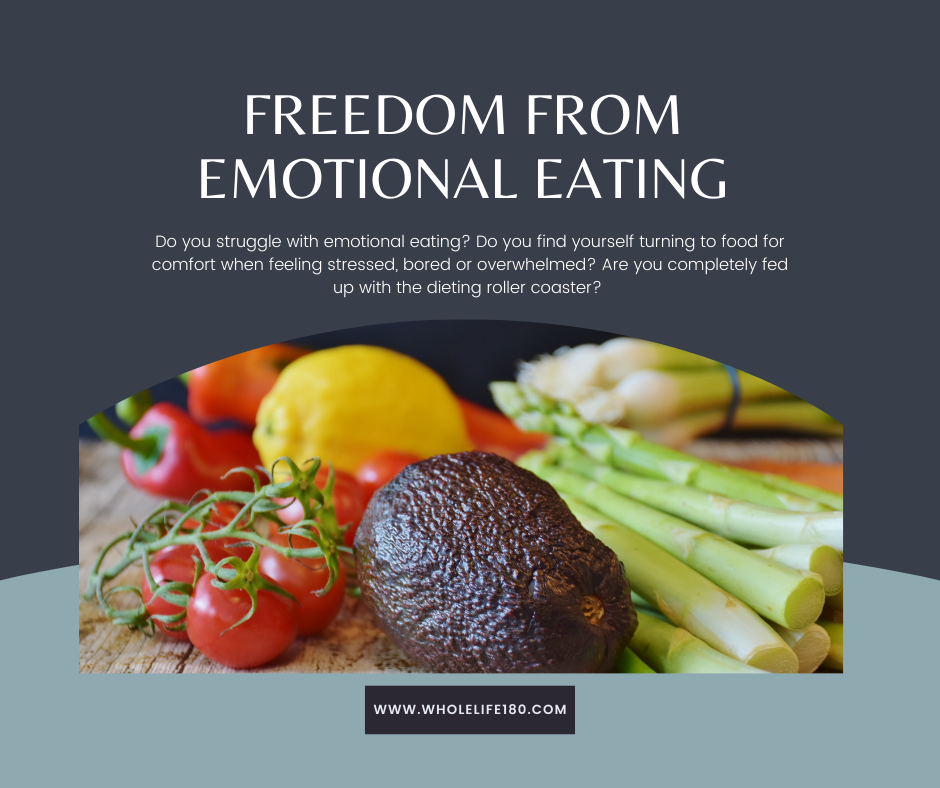
Do you struggle with Emotional Eating? Do you find yourself turning to food for comfort when feeling stressed, bored or overwhelmed? Are you completely fed up with the dieting roller coaster?


We don’t always eat to satisfy physical hunger. We often turn to food as an unconscious response to tough emotions. When going through treatment for my own health issues, as I was trying to navigate my Doctor prescribed dietary protocol, I quickly realized that my wanting to eat was not in response to actually feeling hungry, but I was using food as a way to self soothe from boredom, stress and sometimes just wanting to disassociate or disengage from the world. 


Emotional eating can serve as a way to escape painful memories or emotions. Trauma can significantly impact our relationship with food and eating habits. There is a strong link between traumatic experiences and developing disordered eating patterns. People with PTSD, for example, often struggle with emotional regulation. Food can become a coping mechanism to self soothe and manage intense emotions that arise from traumatic memories or triggers.


The act of eating, especially foods that you consider to be your comfort foods, can provide temporary relief and distraction. This is especially common for people who were soothed or pacified with food as young children. Maybe your emotional needs weren’t met. Maybe your emotional needs were ignored or even vilified. Maybe your early childhood felt lonely, confusing or even dangerous. Self soothing with food might have started as a coping mechanism or survival skill however, turning to these coping mechanisms too often, results in a problematic eating pattern that becomes your default way of being.


To achieve lasting sustainable weight loss and improved health, it’s crucial to address both the physical and emotional aspects of eating. You might benefit from 1on1 support from a board certified health coach who can help you to understand your values, strengths and passions. A health coach will help you learn how to access these superpowers in order to identify and unlearn unhealthy coping mechanisms that might be underlying your emotional eating patterns. Working with a health coach can make it easier to explore alternative coping mechanisms that better serve you and help you achieve peace around food.


Overcoming emotional eating is a journey not a destination. Be patient and compassionate with yourself as you learn to identify and navigate emotions and develop healthier coping mechanisms. Reach out for support from health coaches or therapists specializing in emotional eating and food addiction.


By acknowledging your emotions and finding alternative ways to cope, you can break free from the cycle of food addiction and cultivate a healthier relationship with both food and your emotions. I can help support you on your journey. In your free consultation, I can explain more and answer all your questions. www.wholelife180.com or amyfein@wholelife180.com


By Amy Fein February 18, 2026
When Your Nervous System Learns To Scan For Danger If you grew up with chaos, criticism or instability, it makes sense that you feel “on guard” all the time. Your brain did exactly what it was supposed to do. It learned how to keep you safe in a world that didn’t feel safe. As a kid, were you constantly reading the room? ▪️Is Mom in a bad mood? ▪️Did Dad sound annoyed? ▪️Did I say the wrong thing? In that kind of environment, your nervous system is trained to scan for threat instead of possibility . The brain’s threat systems learn to stay on high alert, always looking for what might go wrong next. Over time, that “watch your every move” environment doesn’t just live outside of you anymore. It becomes an internal autopilot voice that keeps you hyper aware of perceived mistakes, tone, facial expressions and tiny energy shifts around you. That internal voice is active and hypervigilant even when you are safe. When criticism or unpredictability were your norm, your brain adapted. It linked being loved and feeling safe with avoidant behaviors that lessened the chances of feeling stressed or unsafe. Examples of avoidant behaviors include, ▪️Getting it right the first time. ▪️Anticipating other people’s needs. ▪️Minimizing your feelings. ▪️Staying small and non disruptive Eventually hypervigilance gradually becomes your base state. You don’t need a critical parent in the room anymore. You carry that voice unconsciously inside. You might notice things like, ▪️Ruminating and replaying conversations in your head. Cringing at “small mistakes” ▪️You assume you are in trouble when someone is quiet. ▪️You feel like you’re “too much” or “not enough”, often at the same time. None of this means you’re broken. It means that your brain learned a protective survival strategy that outlived the environment it was built for. Where neuroplasticity comes in. Your brain is changeable. Neuroplasticity is the brain’s ability to form new pathways and weaken old ones. What your brain learned from chaos and criticism, it can unlearn in safety and compassion. Hypervigilance and harsh self criticism are not fixed personality traits. They are habits in your nervous system. Habits can be retrained with small, repeated experiences of safety. What’s the first step? Notice patterns. The first step in retraining your brain is awareness. Just neutral, curious awareness. Instead of “what’s wrong with me”, try “This is my old survival pattern showing up. My brain is trying to protect me the way it learned in childhood”. Tiny shifts matter. When you see hypervigilance as a survival code, and not a character flaw, you reduce shame and negative thought loops which keeps the threat system switched on. Repeated messages of safety give your brain new data. When you notice these hypervigilant thoughts, say to yourself, “This is my nervous system trying to keep me safe. Thank you but we are not in danger right now”. Once you start to notice these patterns, and the frequency of these negative thought loops you begin to really understand that your brain learned to pair certain cues with danger. Neuroplasticity work means gently pairing those old cues with new experiences of safety. You’re teaching your nervous system, “we noticed that cue, but we don’t have to launch into full alarm anymore”. Over time, your brain starts updating its prediction from “danger is guaranteed” to “this might be uncomfortable but I am safe in this moment”. Every time you catch the old “script” and offer a new one, you strengthen a different pathway. Repetition is more important than perfection. T Want support with this process? If this resonates with you, if you’re always on edge, scanning for rejection, replaying conversations, I want you to know, nothing about this makes you weak. It means that your brain did its best in a hard environment and now it deserves the chance to learn something new. This is the work. The healing. The great unlearning. When doing this work, I help people with: ▪️Understanding their “survival codes” like hypervigilance and self criticism. ▪️Learning practical, evidence backed ways to calm the nervous system. ▪️Using neuroplasticity tools to build new patterns of safety, self trust and possibility. You don’t have to keep living as if you’re one wrong move away from losing everything. Your brain learned that once but with the right support your brain can learn something much kinder, gentler, and open to possibility.
By Amy Fein October 6, 2025
Letting Go Of Old Thought Patterns Is Possible Thanks To Neuroplasticity